

Unbecoming by Suzette Bishop
Unbecoming by Suzette Bishop
2026//limited edition 60 copies//7×9, 21 pgs.
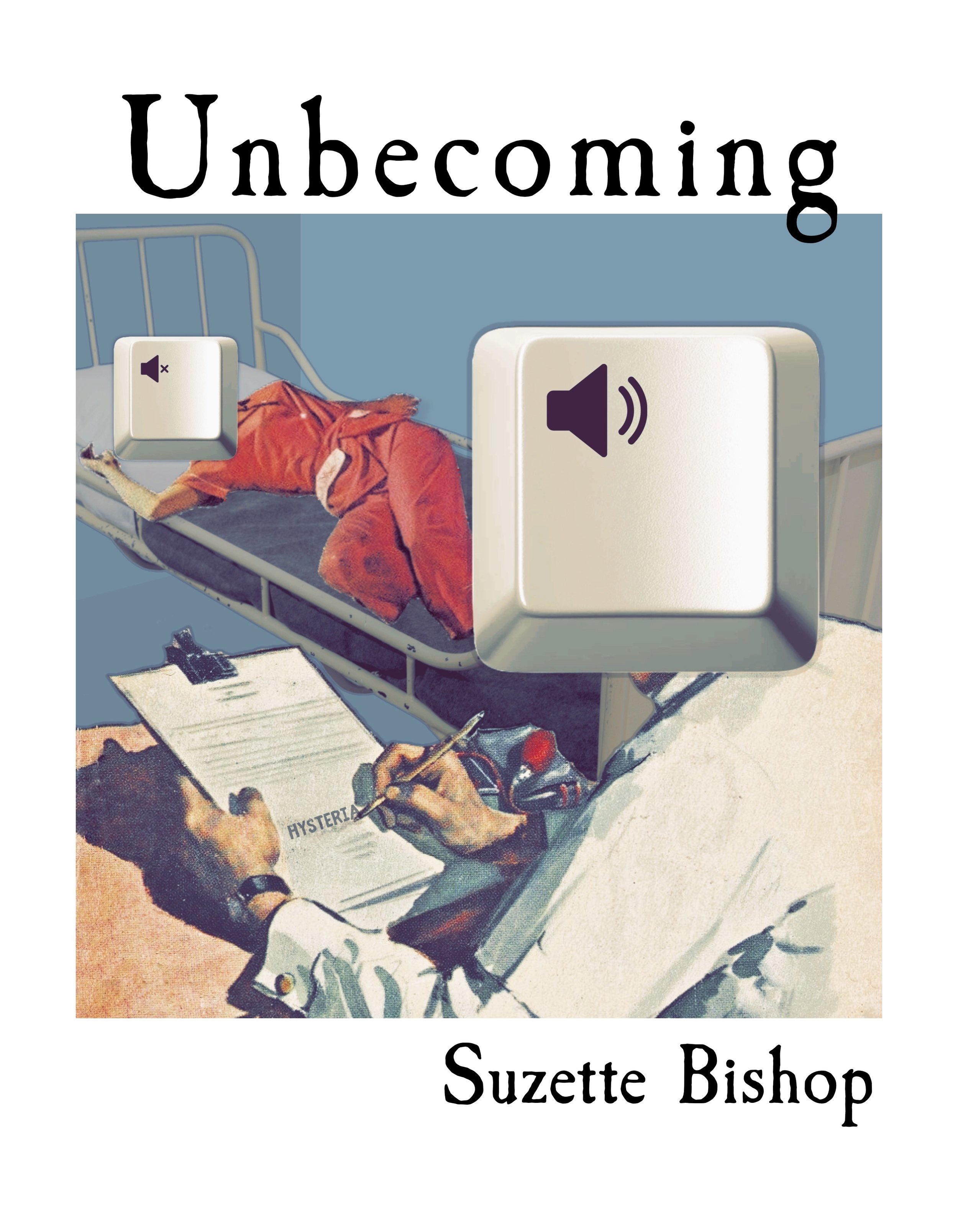
Cover Art © 2024 Best Practices? By Christina Baltais
Suzette Bishop has published three poetry books and three chapbooks, most recently, Eyes of Some Robbers. She has an MFA from the University of Virginia and a Doctorate of Arts from the State University at Albany. Her poems have appeared in many literary magazines and anthologies and been finalists in the Northwind Writing Award and contests at Black Fox Literary Magazine and So to Speak. One poem earned an Honorable Mention in the Coalition of Texans with Disabilities Contest and, another, First Place in the Spoon River Poetry Review Editors’ Prize. She has the invisible disabilities of ME/CFS and fibromyalgia and lives in Laredo, Texas.
Blurbs for Unbecoming by Suzette Bishop:
Suzette Bishop creates an astonishing tapestry in her long poem, Unbecoming, tracing the illness, ME/CFS, with threads that form a fabric of testimonials, symptoms, advice, scraps from the Sleeping Beauty tale, and magical thinking. Bishop’s mélange of texts harrowingly enacts her journey consisting of disbelief and dismissal from others as well as the betrayal of her own body. “Sleeping Beauty finds webs around her like a cocoon,” she notes, and with multiple voices she pulls us into her struggle along with the stubborn resistance from her soul and mind, enlightening us with her wisdom and expressiveness.
—Molly Bendall, author of Turncoat and Watchful
This chapbook was an arrow directly aimed at my heart, and it pierced it through. I cried and in the end we triumphed. The lines in this poem cut deep, but the scars left behind heal, and I only wish I could write so eloquently. Suzette Bishop is a fairy full of magic.
—Cynthia Dougherty-Bernal, author of Looking into Infinity and Bleeding on the Page
Suzette Bishop’s lyrical and authoritative chapbook, Unbecoming, is a compelling and devastating account of the very real suffering of those with ME/CFS. In just a few short pages, Bishop thoroughly and convincingly illustrates the indignities and downright dangers a sufferer must navigate when she is invalidated, gaslit and disappeared by the world around her: The institutions, experts, family, employers, and cultural narratives we’ve been “taught” to trust and need for our physical and mental survival. The stigmatized ME/CFS sufferer is robbed of “That glorious word ‘valid’”.
Bishop’s technique of twining the various narrative threads of research, individual experience, and the fairy tale Sleeping Beauty demonstrates the speaker’s attempt to remain intact and coherent while pushing back against disintegration and “existential despair.”
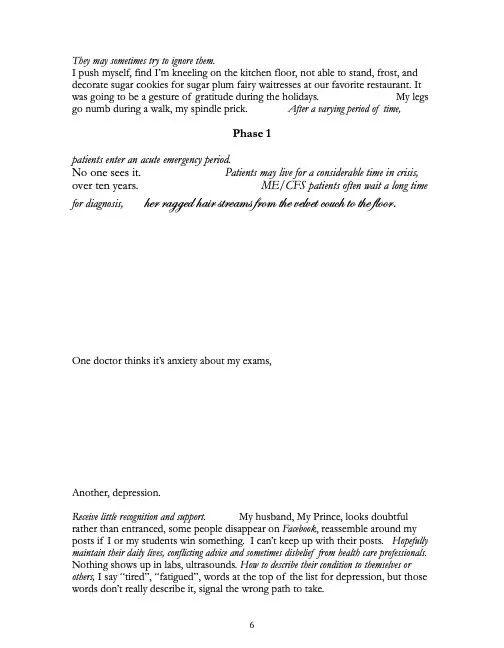
At times the narrative form breaks down and words sprinkle down the whiteness of the page. Like an SOS, the sparsity of words forms a Morse Code of dots and dashes, which seeks someone who understands the distress signals.
Breaking the sections into “Phases” and sharing poignant reminders of activities and identities no longer available to the ME/CFS sufferer (“my horseback-riding gear hung by the door, unused, but still smells of horse”) serve to point out that this is a degenerative and progressive disease.
The impact on the reader is visceral and immediate.
With each “Phase” of severity, the reader senses that the speaker has moved past screaming to be heard and is now exhausted, speaking in a whisper. In that whisper comes a new clarity, like a diamond crystallized under extreme conditions. Her words are culled down. Hard won.
The absolute destruction that ME/CFS wreaks in a person’s life is demonstrated here with clarity of purpose and strength of heart. By book’s end, the speaker asserts, “I’m not minimizing” and “Sleeping beauty wakes.” When all is said and done, there is, unexpectedly, hope.
That this piece exists at all is a sign of hope. We should all recognize the need for such hope, as we face the possibility of our own vulnerability striking unexpectedly: “How thin the border is between health and illness . . . between able-bodied and disabled . . . between career and unemployment . . . between control and disjuncture.” With Unbecoming, Bishop calls us to recognize our own humanity and the vital need for compassion both for ourselves and others. A message, while going “back to the beginning of the human species,” couldn’t be more timely and necessary.
—Nancy Dunlop, author of Hospital Poems